
Renaissance Books

Most of history is much like today: times of social, technological and philosophical stagnation. The greatest flowering of humanity thus far is that of Ancient Greece; everything we have today above the use of Iron and Bronze more or less dates from then; rational worldview, the beginnings of science of all kinds, history, philosophy, technology: none of it would have happened without the Greeks. The periodic revival of the Classical ideal seems to be associated with great leaps of progress. Renaissance Italy is one of those times and places. Arguably the one where the greatest revival and the greatest leaps forward took place; the Iberian explorers being a sort of continuation of this bold spirit at the edges of the world.
There are lesser revivals: one could look at the progress of the 19th century as a minor Classical revival in Germany, France and England. The high middle ages; a time of enormous prosperity where the scientific method was codified under the Catholic church was another such revival (Spengler places the origin of our Faustian civilization there). But they all pale before the Renaissance; the mightiest and most exuberant.... hence the name: Renaissance.
Men of the Renaissance were not limpid hot house flowers in tights. Like the Ancient Greeks they were mostly characterized by tiger-like ferocity. They were physically ferocious: it's not known to me what manner of bodybuilding they were up to in those days, but both the art and the contemporary accounts make it clear that physical fitness was of paramount importance. They played games like Calcio Storico which were effectively giant brawls, and local politics wasn't much different. Leonardo, who is for some reason depicted as a fragile doddering old boffin could bend horseshoes with his bare hands. For the usual reasons, flacid dimwits with desk physiques denounce the renaissance physiq as being the fantasies of a bunch of fruity art-fags, but you don't bend horseshoes with limp wrists.
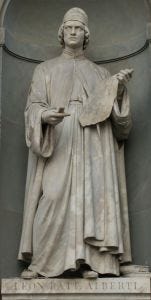
Leon Battista Alberti could kick your ass
The Renaissance also poses difficulty for those who think Christianity somehow drains the vitality of Western Man: everyone we're talking about below was Roman Catholic with a religious zealotry beyond anything seen anywhere intheworldtoday. The Pope had an army and was a man of action: even a man with a biological dynasty. Yet, he was still the Pope, and the Pope is generally considered pretty Catholic. Italy was far more Catholic in the Renaissance than it is today. It was also a lot more filled with vitality than current year Shitaly; brawling, fornicating, adventuring, building and creating the world's greatest treasures.
The Civilization of the Renaissance in Italy Jacob Burckhardt. Burckhardt wrote one of the great historical surveys on ancient Greece; in this two-parter he brings his historians eye to the second greatest flowering of the human race, the Italian Renaissance. Like his other famous book it's a historical survey, going over art, its place in society, morals, individualism, tyrants, the reproduction of antiquity, the schools, the great powers of the day and the decline of humanism in the counter reformation. It was Burckhardt who made the assertion that the middle class concept of the individual was born here in the Renaissance. It's an idea that remains popular, along with the fedora atheist idea that people like Galileo were .... fedora atheists (Galileo was extremely Catholic, and his problems were with a political faction rather than a religion). While Burckhardt paints a compelling picture in this matter; it's pretty obvious if you read beyond his book (actually even if you just read his book) that he was projecting the problems of his own time onto that of a past he admires. Amusingly Burckhardt was a pal of Nietzsche which makes a lot of sense.
Vasari Lives of the Painters, Sculptors and Architects. This isn't a book I have read cover to cover (it's almost 2000 pages long); more of a thumb through it when you're bored kind of thing. It's a bunch of pocket histories of the great "Renaissance men" who worked in the arts, with some comments on their character and achievements. My art history background consists of a university course from 30 years ago, and watching Kenneth Clark's Civilization, so other than the big names most of the guys listed here draw a big old blank with me. Of course if you google the names you can see some of the things they achieved. Occasionally amusing friends of the artists come up as well. For example Nunzita, friend to Ridolfo Ghirandajo who was a puppet painter, practical joker, maker of fireworks and lewd paintings. Every time I pick up the volumes of this book I'm transported into this world of charm and excellence; artistic glories which continue to astound the whole world. Yet they were from a tiny region of a few million people over a few score of years, and that was just the artists.
"The Craftsman's Handbook" Cennino Cennini. This is one of those books you're going to have kicking around if you're interested in painting in egg tempera (I fool around sometimes, no you can't see any of it). It's still a useful reference; I picked it up again while learning gilding a few months back.
My Life by Benvenuto Cellini. This is a book like Casanova's autobiography which captures what it is to be an important man in this important era. Cellini was not only a great artist, he was a soldier, freebooter, courtier and practical joker. His account of the pouring of the Perseus statue is unforgettable and relatable to anyone who has had an obsession or great goal in life. His other adventures are similarly vivid: his mockery of other sculptors, his revenge-taking with crossbow and sword, parties, meetings with famous men. I've read it twice and if I didn't know it so well, I would read it again: this is a top recommendation for anybody with spirit.
Power and Imagination City States in Renaissance Italy by Lauro Martines. One of my ex girlfriends bought this for me a couple of decades ago when we were reading Casanova's memoirs and Cellini together. I apparently stopped reading it in Hungary which I haven't visited since 99 (there's a 200 forint bill for a bookmark), but I picked it up again recently and powered through the whole thing. It's an account of the social development of medieval Italian cities through the Renaissance. Anyone who has looked at a little Dante knows a bit about Gulephs and Ghibelines, but the vast clashing violence of the whole area, and the huge upheavals between social classes, bishops, men's self defense clubs, religious associations, guilds, and so on is something most people don't know about. The social organization of these cities were sort of like Fustel de Coulanges Ancient City in that there were very powerful clan groups living hip to elbow in these places. They also went through various stages of aristocracy to popular rule to oligarchies, and the overall structure of oligarchy is probably similar to how we are governed today: mostly via secret councils. Very interesting small details about social development of different social classes in the different republics. For example, while John Julius Norwich's A History Venice (top tier history for Venice -his Byzantine stuff is also great) might go into the various wars, overall economic conditions and so forth, he won't tell you thinks like the nobility of such and such an era was more and more decoupled from merchant activities and more and more devoted to rent seeking. This book fills that kind of gap.
A Treatise on Painting by Leonardo Da Vinci. It's not something you can learn to paint from, but it is kind of amazing it exists at all. It has weird little bits of advice on painting figures, hands and so on, which evince an incredibly astute eye for detail. Skill is important but how someone like this approaches the problems, tricks of the trade and so on.... most of it isn't even actionable but it is interesting.
A Florentine Diary from 1450 to 1516 Luca Landucci. Author was a local apothecary in Florence; a regular middle class person. Most of it has the character of local news. Ambassadors from Venice, Geonese merchants brawling, hermit assassins tortured to death, indulgences from the pope, cases of plague, new public art, treaty with the French, price of corn and oil up on anticipated papal visit, public executioner lynched by angry mob, rogue preachers, etc, etc. Adds some primary source color from a normie of the times. Utterly baffling of course if you have the image of the Renaissance in Florence as being a time when fruity dudes in tights run around painting pictures of each other and passively reading books.
Francesco Guicciardini Ricordi (Maxims and Reflections). Friend of Machiavelli and student of Marsilio Ficino (also a great aphorist), he was a man of affairs of his time, best known for his history of Italy. These are mostly historical and political aphorisms, though some amount to a sort of general wisdom literature, a la Baltasar Gracian. You could look on it as a sort of compressed, aphoristic Machiavelli. Probably the best set of aphorisms for the political or business operative. FWIIW I originally came across him in a sort of list of great aphorists which I will eventually cover in another book list.
Previously covered relevant books, Galateo,