
Beyond Quantum with Khrennikov

I’ve gone through Khrennikov’s “Beyond Quantum” book and write some notes for the crowd. I’ve also had a look at his book “Contextual Approach to Quantum Formalism,” and at least glanced at his more fruity books. Mostly this is a review of Beyond Quantum, which is a presentation of a group of “sub quantum” ideas. Namely Prequantum Classical Statistical Field Theory (PCSFT) -an idea for deriving quantum mechanics from a sort of field theory of classical randomness. By “a field theory of classical randomness” I mean Khrennikov assumes that quantum sized systems are bathed in random perturbations. He seems to remain agnostic as to the origins of this randomness, which is probably a good idea, though he occasionally (confusingly) mentions vacuum fluctuations. This terminology was a bit confusing to me at first, though indeed they are well defined mathematical fields. I guess these sorts of random fields get used in deeper sorts of statistical physics to represent the microstates. Anyway, little stuff of any kind will experience lots of random forces: that’s just common sense.
As one might expect, it’s not a completely satisfying theory, or everyone would know who Khrennikov is, but it is a very fair, fairly rigorous (though the level of rigor arguably doesn’t matter, and I wish more “theorists” would recognize this), and probably a good first step towards whatever is coming next. There are other such related ideas out there, but this is a review of this work which promises more generality and testability.
The most satisfying part of the book is the opening chapter where Khrennikov takes great pains to explain where we get our ideas about Quantum mechanics: detectors. Working your way backwards from detectors is the source of all truth. You don’t learn anything drawing imaginary qubits on the blackboard (I suppose these types use whiteboards now: the heady fumes of which influence the absurdity of their subject), you have to start at the detector and work your way back to the abstractions, which are only useful for telling you what’s going to happen at the detector.
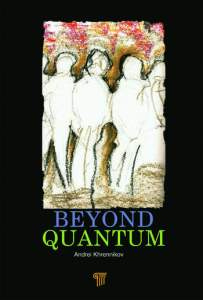
Oddly available at Walmart even though it took Amazon 2 months to deliver it to my house
One of the important points he makes is a distinction between Kolmogorov probability versus contextual probability. Contextual probability, well it is sort of like a Jaynesean conditional probability, though Khrennikov is a lot less flippant (he later restates Jaynes argument later in terms of his pre-quantum model in section 3.2) and a lot more rigorous about it. It’s a less intuitive but similar argument. He phrases it in terms of detector calibrations, again working backwards, pointing out that all the Bell experiments are done with independent threshold detectors, which are by their natures not calibrated. Bell’s inequality violations can mean things aren’t local, or, more generally, that the detectors are different enough, or .... quantum mechanics itself isn’t actually a theory about Kolmogorov probabilities, but something else. The detector thing is obviously true, and unlike many autistes who make assertions like this, he makes actionable (though very difficult) suggestions for things that don’t have the properties of photomultiplier tubes. FWIIW I have used these things, and in fact continue to do so with my astronomy hobby (MCPs anyway, same difference); the points he makes about calibrating them are obvious if you fiddle with one for a few minutes, but nobody talks about it. In essence; every deeply quantum experiment ultimately involves an electron flying out of your detector rather than a direct measurement of a photon, and using such detectors it’s basically impossible to tell the difference between a noisy electromagnetic field and an actual photon. Khrennikov’s suggestion is to perform classic experiments using tungsten-based superconducting transition-edge sensors (W-TES) -there are newer detector designs which might also achieve the same thing; Thermal or Microwave Kinetic Inductance detectors. These doodads could in principle detect fraction of a photon energies, effectively using calorimetry rather than the photoelectric effect.
Amusingly the origin of his sub-quantum (he prefers “pre-quantum” -but really it is sub-quantum) theory was in a presentation of error propagation in Russian artillery book. Fortunately for me, there was a presentation of the same idea in an experimental physics book I used in undergrad days, so I immediately understood the basic argument. It is an idea I have actually used a number of times in my career, including post-physics career. The idea is if you have a complicated relation, and you’re measuring at one end, with noise happening at the other (say, Artillery tables), you can figure out what you’re looking at in terms of error on the measurement end considering the error at the actual end. The surprising thing is the first order term (and all the odd terms) always cancel out if you assume the noise is Gaussian (pretty good assumption in physics if you wait around long enough). The second order term defines everything because the fourth order term is effectively going to zero. This is a convenient and useful trick. What inspired Khrennikov about it, presumably encountering the idea later in life while musing things on quantum mechanics, was the idea that one could construct a pre-quantum theory of classical random fields from which you could derive all the ideas of quantum mechanics using this second order idea, which corresponds to the Born rule.
The book itself is not ordered as I might like it. First chapter where he displays his background opinions is very strong. Khrennikov makes some weird assertions here and there which he appears to pull out of his butt, perhaps in hopes of interesting “quantum computard” types (at some point implying a pre-quantum computard would be even moar computard than a regular quantum one, I guess forgetting that quantum computers are more or less nonsense according to his own theory). The second chapter is a nice formal review of what quantum mechanics actually is. Third one bogs down into a lot of unpleasant details in a notation not terribly familiar to me, laying out some of the details of his PCSFT (prequantum classical statistical field theory) with a few seemingly irrelevant details thrown in the discussion.
Of greater interest: there’s an abstract experimental test presented in section 3.11, and a good argument that asymmetric wavefunctions are the place to look for higher order deviations from the Born rule (which is the second order, or correlation matrix of the pre-quantum bits). There’s even a new physical constant for this, alpha , representing the scale of the pre-quantum jitter (equivalent to the sigma^2 expansion in the artillery table error budget thing). Annoyingly Khrennikov’s flirtation with detectors and such in the first chapter doesn’t reduce to particularly practical advice here, though he does point out that Gaussian particles in a box or asymmetric wave functions (which presumably arise from asymmetric potential wells) would be good test cases. I suppose either of these examples are potentially actionable, but something like a quantum trampoline or atom trap with an error budget and interesting frequencies to look at would be a lot more appealing. He also mentions previous explicit tests of the Born rule, such as the triple slit experiment, which shows more higher order interference than the two slit experiment if there is any there. Though I think it is more a test of third order interference which Khrennikov doesn’t think exists. Sorkin’s pre-pre quantum idea which motivated the experiment, while interesting, is more kvetching over the fact that nobody can quantize gravity using hand wavey arguments. I’m not sure why he thought third order interference would be important other than the fact that it is higher order than the Born rule. FWIIW the experiment itself looked like something I could do better in my tool room with a laser pointer: someone should do a better version of this and talk more about coherence lengths.
Chapter 4 gets off with a bad start for me with the statement that the use of complex numbers is somehow a mystery of quantum mechanics. I may be a quantum retard, but phase isn’t particularly mysterious to me. The fact that the first iteration on the Schrodinger equation left out the complex numbers at the price of making it a fourth order differential equation kind of gives it away. Schrodinger was a smart fella and got tired of differentiating four times, so he showed us a way of only taking the second derivative. Somehow people don’t go look at his original series of papers. Or they confuse themselves talking about cranked Hilbert spaces or Wick rotations or whatever. Yes, yes, quantum probabilities have a phase term and that’s kind of odd, but it isn’t that odd. I can think of all kinds of electrical engineering “probabilities” with phases in them. FWIIW I’m a moron when it comes to trigonometric identities (daily weed bro during my High Skrewl trig classes), so I always use complex numbers to remember how triangles work. Why do triangles have complex numbers in them? Why does my three phase power outlet have complex numbers in it? These sorts of questions do not rise to the level of Juggalo “how do magnets work: it must be magic“ thoughts. I suppose Khrennikov is constantly surrounded by people who insist on quantum mysticism, so maybe he’s throwing those guys a bone, but to me it’s a jump-scare of pure insanity in an otherwise perfectly sensible, even bloody-mindedly sensible monograph. The rest of this chapter is motivation for looking at QM as prequantum fields. For this wrench wielding former experimentalist grug, Hamilton-Jacobi is enough. I assume this came out of discussions with other theorists who were worried or objected to various pieces of his idea.
Chapter 5 takes us through quantum mechanics for naval officers; his artillery table thing, where he makes the actual argument of the theory that you can get something that looks an awful lot like quantum mechanics considering sub-quantum observables subject to random fields. This to me is the key chapter of the book, and if I had written it, it would be chapter 3, with most of chapter 3 (which is mostly a mop-up operation for this chapter) turned into chapter 5. This is a difficulty I’ve flagged on a lot of books written in solitude, such as my pal’s book on Parmenides: the author is so locked into his idea, he forgets that he’s communicating the idea to other people who have no idea what he’s talking about, and that for didactic purposes it must be presented in a certain order for others to get what’s going on. Contra his assertions in chapter 3, every experimentalist will be familiar with the math and arguments in here, and there’s nothing tricky or abstruse about it. There are actually very recent developments in stochastic calculus which would make his argument much more natural and compelling, but he wasn’t aware of them at the time (I asked). I may write something about this myself later, though there are for whatever reasons only a few physics types thinking about these developments, making my audience “data scientists who retain an interest in mysteries of quantum physics.” I guess the math is pretty hard and the payoff non-obvious to people who don’t play with data all day, aka all theoretical physicists, who arguably should be playing with data all day instead of blowing theoretical soap bubbles. Last section in chapter 5 is an important one; what to expect if the random field mean frequency is someplace between the Planck time and the Compton/Zitterbewegung time.
Chapter 6 meh, I got nothing out of it; give grug tools, not formalism. Some of it looked like necessary cleanup of stuff he left hanging, some of it didn’t. Chapter 7 is more important: what happens with composite (aka entangled) systems? A bit disappointing no clear directions for experiment here, but as experimentalists are barely able to entangle a couple of photons, perhaps it’s no big deal. Chapter 8, we come back to my favorite subject: detectors. He develops a formalism for modeling detector responses to classical random fields, then applies it to what a quantum measurement would look like under his PCSFT model, which eventually more or less justifies the stuff he said in section 3.12 about places to look for deviations from the Born rule, rather unfortunately invoking renormalization type ideas in the process. While his detector model will have a lot of familiar elements to other physicists, I’m pretty sure there are better ways to think about this sort of thing (which, of course, will end up being more or less this, but might be less awkward in getting there). The last section showing that quantum mechanics expected observables are linear filters on noise is pretty good. Anyway Chapter 8 is important even if it is not to my taste, because you can’t get quantum mechanics without detectors; you might say, it is an artifact of sensitive detectors. Chapter 9 further makes the point that quantum mechanics can be seen as something that happens in detectors, and points out another test of PCFST in better single-photon interference experiments such as the one done by Grangier, Roger and Aspect. It’s the most physics-ey, least formal chapter, and so is not one you should skip over, rather, read 1,5,8,9,3 in something like that order for maximum benefit (IMO).
For criticisms: mostly, the style. It’s very formal; the author is a current year theorist who has spent large portions of his career writing very careful papers on probability theory which require formalism. The idea at the core of it stands without any of the formalism: it’s a physical idea. In general, it would make me and everyone else happier if he festooned the formalism with more hbars and talked more about non-commuting operators. Theorists hate putting the \hbar’s in (so does substack apparently). You can kind of do it by eye, but I, for one am over 20 years out of practice doing such things, and saying more about non-commuting operators where we stick our \hbar’s would make for a stronger argument. Yes, he does go into this in chapter-5 in a jargony way, which I’m not completely opposed to, but it could be relayed in a more physical way. Maybe a few worked out examples where he goes from pre-quantum fields to a well known quantum mechanical result so people can reassure themselves the formal math does its mathing properly.
One thing that occurred to me from start to finish on the thing, my favorite wacky fun physics idea of the electron as a photon on the torus. Yes, this absolutely fits into Khrennikov’s framework, and considering his friends I am sure he is aware of it. Photon on a doughnut makes very specific and true predictions, where Khrennikov’s thing is a rough sketch you could drive a Russian tractor through. That’s fine, we can squeeze it down until all the formalism fits reality more precisely. Getting people motivated and marching in the right direction is enough. Anyway I’d have written the book differently, but it’s an important book and everyone interested in foundational physics should read this (perhaps with some of my chapter suggestions above to make it go down easier). Anyway an excellent group of ideas of the highest quality: a must read for those contemplating the mysteries.